


The conversation around artificial intelligence and work has changed dramatically in recent years. It is no longer about whether AI will replace jobs, but about how it can enhance productivity and free up strategic time within organizations.
In 2026, the real challenge is not adopting artificial intelligence, but deciding where to start. The key question is not what can be automated, but what should be automated first.
Many companies make the mistake of trying to apply AI to complex processes from the beginning. They aim for deep transformation without generating prior learning. The result is often frustration, low internal adoption, and projects that lose momentum. Intelligent automation requires prioritization.
The first criterion for deciding which tasks to automate is repetitiveness. Processes that are performed every day, follow clear rules, and consume operational time are natural candidates. Administrative workload, information classification, responses to frequently asked questions, or report generation are typical examples. When these tasks are automated, the impact is immediate: time is freed up and the margin of human error is reduced.
The second criterion is volume. Processes that scale as the business grows often become bottlenecks. If each new client implies more manual work, the structure is not sustainable. Artificial intelligence makes it possible to absorb that growth without multiplying costs at the same pace. Automating support tasks, data processing, or preliminary analysis can directly improve scalability.
A third key factor is the impact on customer experience. In increasingly competitive markets, response speed and personalization make a difference. Implementing intelligent assistants, recommendation systems, or automation in sales follow-up can significantly improve service perception without increasing team workload.
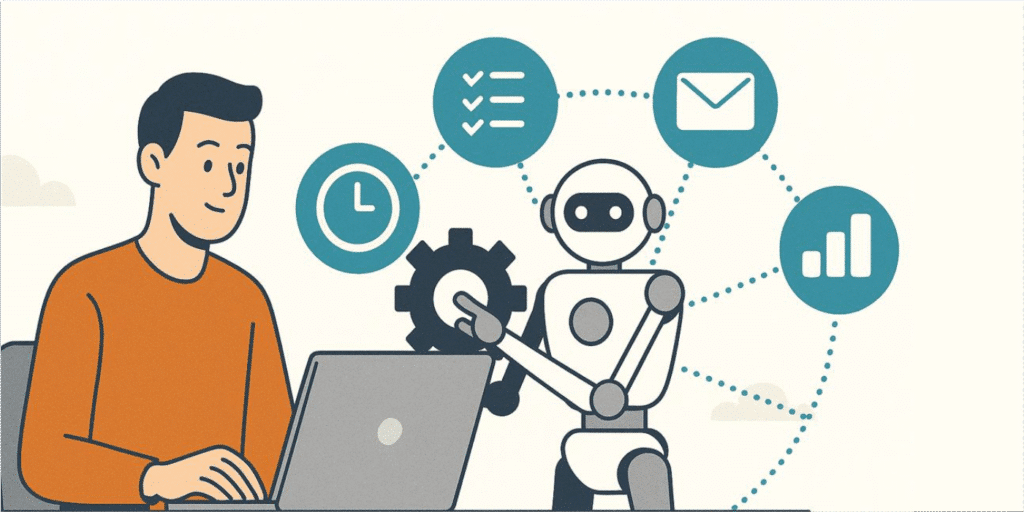
However, automating does not mean eliminating human judgment. The companies that integrate AI most successfully are those that combine automation with strategic oversight. Critical decisions, contextual analysis, and creativity remain core human competencies. Technology amplifies capabilities; it does not replace vision.
Another relevant aspect is process clarity before automation. Artificial intelligence performs best when operating on defined workflows. If the process is confusing or depends on improvised decisions, automation will only amplify disorder. For this reason, before incorporating AI, many organizations need to map and simplify their operations.
In 2026, a strategic dimension also emerges: automating tasks that improve decision-making. Predictive analytics systems, intelligent data classification, or pattern detection can provide faster and more accurate information for leaders and teams. In this case, the value lies not only in time savings, but in the quality of decisions.
There is also a cultural dimension. When teams perceive that AI eliminates repetitive tasks and allows them to focus on higher-value activities, adoption becomes more natural. On the other hand, if automation is communicated as disguised workforce reduction, resistance increases. The way the AI strategy is presented directly influences its success.
A common mistake is automating isolated tasks without an integrated vision. Real transformation occurs when automation is aligned with clear business objectives. Reducing response times, increasing conversions, improving internal efficiency, or scaling operations must be explicit goals.
It is also important to avoid automation driven by trends. Not every task requires advanced artificial intelligence. In some cases, a process improvement or simple technological integration delivers sufficient results. The key is choosing the right tool for the right problem.

Companies that achieve sustainable results with AI typically follow a progressive approach. They start with high-impact, low-complexity processes, measure results, adjust, and scale gradually. This logic reduces risk and generates organizational learning.
The relationship between AI and work in 2026 is not a battle between humans and technology. It is a redefinition of roles. Operational and repetitive tasks tend to be automated, while strategy, creativity, negotiation, and empathy are strengthened as human differentiators.
The real value of automating the right tasks first is regaining focus. When teams are no longer trapped in constant operations, they can concentrate on growth, innovation, and continuous improvement.
At Lab9, we support organizations that want to integrate artificial intelligence with strategic clarity. We help identify which processes to automate first, how to implement them without generating cultural friction, and how to measure real impact. Because automation is not an end in itself; it is a means to build more agile and sustainable companies.
In 2026, the advantage will not simply be using AI. It will be using it where it truly matters. Contact us.