
Consultancy · Development
Google Bay View, the sustainable campus of Google Inc. - The tech microuniverse Silicon Valley: Vol III
It has been a quarter of a century since the dynamic duo Page-Brin popularized a fun but unique word: Google. As if by magic, a few touches of a wand were enough for that project that was born in a garage to transform into one of the most impressive complexes in all of Silicon Valley. That's right, we're talking about Google Bay View.
Legend has it that those who want to prosper with their business idea within Silicon Valley must meet the following requirements: dream in pairs or more, take the first steps in a place similar to a garage - just like the HP case -, have severe bouts of creativity and trusting that things will happen.
Like the founders of Hewlett Packard, those who gave life to Google met as graduate students at Stanford University. Unlike the first, Sergey Brin and Larry Page, made use of their computer genius to make people's lives easier. The year was 1997 and the mission was clear: develop a search engine that organized the world's information to make it universally accessible and useful. Success was predestined.
Google Inc. Effect
Initially it started as a simple website that classified web pages based on the number of pages that referred to them, but then the bet grew more and more, until it became an umbrella brand: from products related to daily life like Google Home to services designed for corporations like Google Analytics.
The growth of the company was so exponential - in the best "googol" style - that at the beginning of 2000 they decided to buy four buildings located in Mountain View. From there, the takeoff knew no limits and maintained its sustained growth until in 2017 its founders decided to go for more to start drawing another of their great dreams: to build the first Google campus with a zero carbon footprint.
The Google Bay View Campus
This time the motto consisted of three fundamental pillars: innovation, nature and community. These would be the parameters when imagining and designing what would be one of the most avant-garde constructions in the world at an architectural and organizational level. The land that houses this megaproject is located in Silicon Valley - like Googleplex, the original headquarters - and consists of 17 hectares, which include closed and open spaces.
Dream that you can working in a 100% carbon-free space ceased to be a mere ideal when the Google steering committee and architects joined forces to create something unthinkable: offices designed with sustainable innovation, focused on Google's future worker. An eco-friendly work environment 24 hours a day, 365 days a year.
The plan took five years to complete - it began in 2017 and ended in May 2022 - and was premised on the construction of two workspace buildings, an event center for 1,000 people and 240 temporary accommodation units for employees.
The spaces were designed for teams to work on the upper level and the meeting spaces on the lower level, delimiting the areas of concentration and collaboration. When fine-tuning the sketchbook, it was thought that it would be ideal to give life to places that stimulate constant contact, as well as co-creation and collaboration.
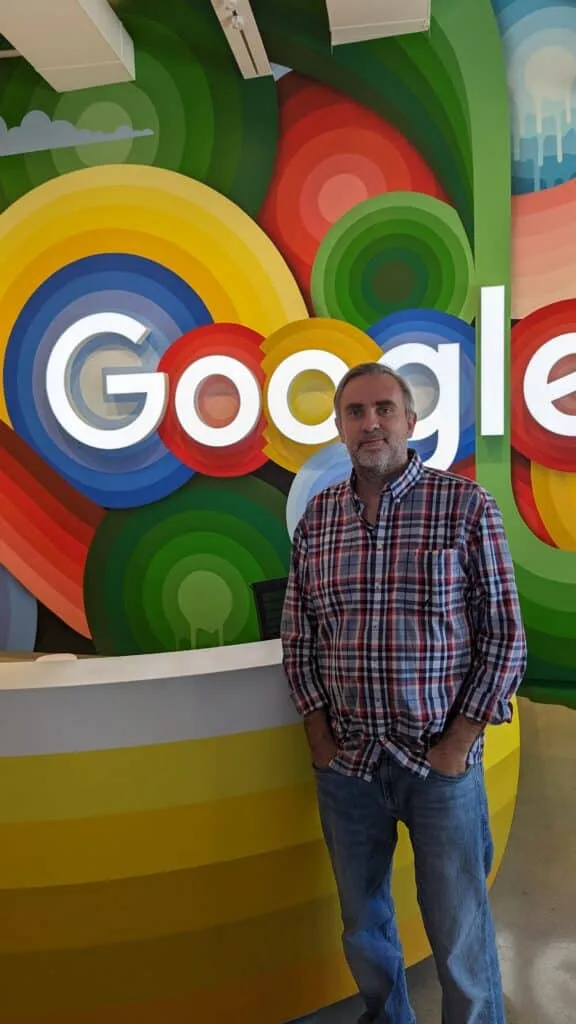
During his Bay View visit, Alejandro Jatib -founder of Lab9- was able to observe an intelligent design in the spaces that connects both levels through interior patios. Its purpose was to facilitate people's access to essential areas such as cafeterias, kitchens and conference rooms.
The Google campus has two notable features. On the one hand, it is known that its facilities run entirely on electrical energy and, on the other, that it houses the largest geothermal stack system in North America - a carbon reduction of 50% and the water used for cooling by 90% is estimated.
On the outside, the buildings have a “dragon skin” roof equipped with 90,000 solar panels that generate a total of seven megawatts of energy. Thanks to them, all the photons are collected.
In addition, the stormwater systems that were also part of the grand plan, collect, treat and reuse water, providing habitat restoration and protection against sea level rise. The conservation of the natural wetlands of the Bay Trail is also guaranteed.


The new paradigm
Using the modular construction technique, the Google Bay View invites you to experience the work routine from a totally innovative approach: the same surface area as one of the tallest towers in San Francisco but distributed in such a way that it allows for an open view of the landscape, acoustic neutrality and preservation of the environment. Incredible, right?
Everything that involves modular construction, geothermal energy at new scales, innovation in the design of photovoltaic energy, diversion of waste from landfills, intelligent water management and preservation of threatened fauna, is present here, in Google Bay View.
The roof of the buildings resembles tents of colossal size at 34 meters high, standing out for being a highly flexible envelope separated from floors and walls that allows the creation of an agile-adaptive environment that accompany the changing needs of collaborators.
We invite you to follow closely this special and exclusive series of notes on Silicon Valley, to travel for a few minutes to the mecca of technology!