
Consultancy · Development · Marketing
From brainstorm to breakthrough: the history and phases of the Design Sprint
Surely it happened to you more than once to have millions of ideas in your head, super creative, innovative, original and brilliant for your business. However, we are not always very clear about the phases, how to carry them out or which paths are the most efficient to achieve it.
Statistics by Clayton Christensen, professor at Harvard Business School, revealed that 95% of new products fail, and that 92% of startups do not survive the three-year barrier.
In a world that constantly demands speed and instantaneity, we are obliged to abide by these “survival criteria” when setting strategies and objectives for our business. How many projects are not carried out or are left half done due to lack of time? Or, on the contrary, how many go on for too long without finding an efficient and profitable solution?
It was in this accelerated global context that Jake Knapp, a designer working for Google Venture, created the Design Sprint in 2010, with the aim of answering some of the critical questions for product development through design, prototyping and customer testing, combining Design Thinking tools with agile methodologies, to obtain a 5-day process in which to "validate" ideas. In 2016 he published a book titled “SPRINT”, where he shared all the details about this methodology.
If you are interested in knowing more about the definition and essence of the Design Sprint, you can click here and read the article on our blog.
FOUR PHASES, FOUR DAYS.
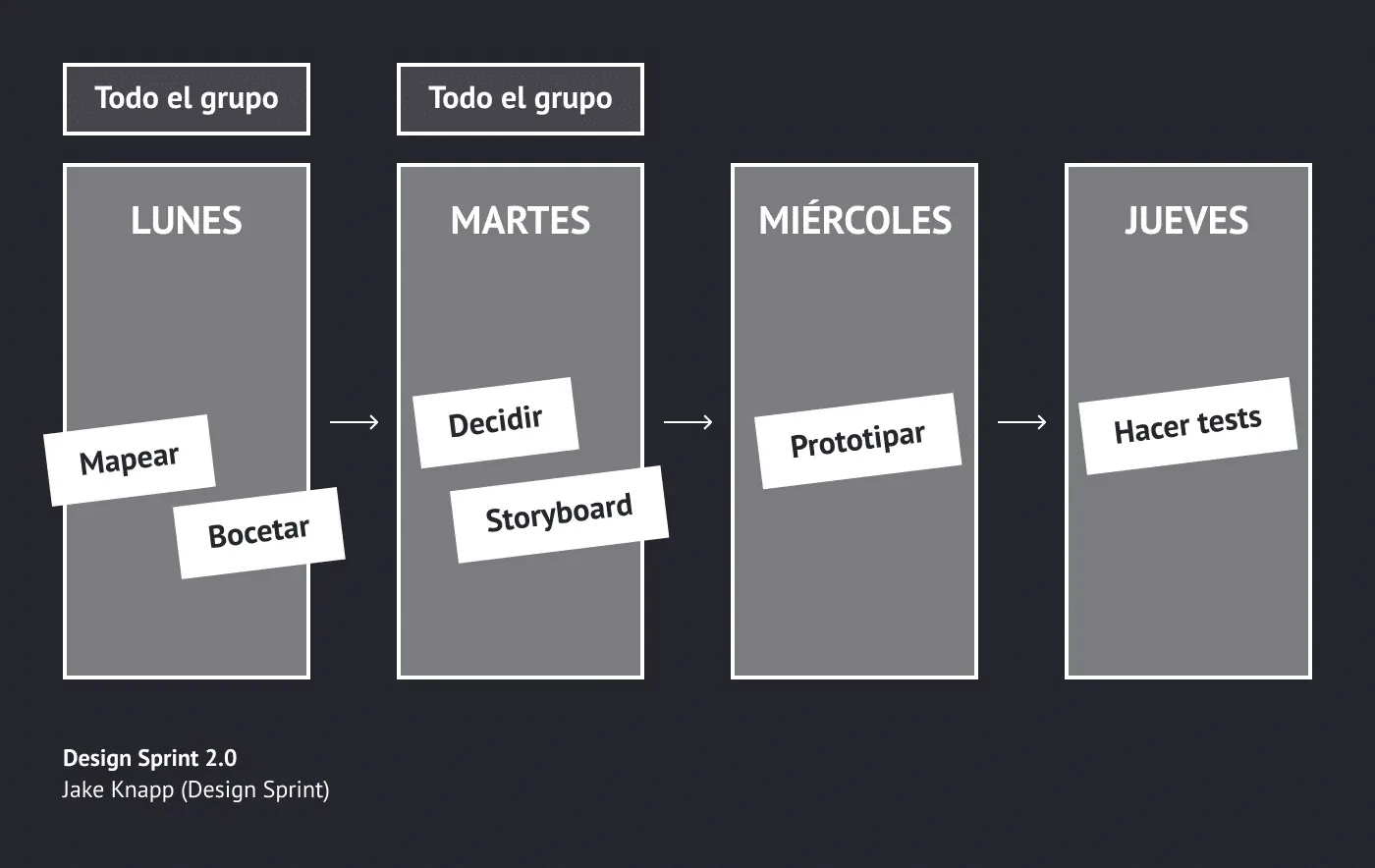
Although at first this methodology consisted of 5 phases, in 2018 its version 2.0 was put into effect, endorsed by Knapp himself, where the process was simplified, leaving only four phases distributed over four days. No steps are eliminated, but time is optimized and it also allows the work team to be released sooner.
So, how do we organize ourselves?
Before starting, we could add a so-called “Phase 0” that will serve to take into account some previous aspects that are fundamental for the success of the methodology. The tasks of this stage are:
- Choose your work team: ideally it should be made up of 5 to 7 people, and if they are from different areas, much better.
- Reserve two full work days on the team members' calendar.
- Make a general overview of the information you need: a superficial investigation, prior to phase 1, helps organize the data more quickly.
- Write a short document, detailing what the design sprint aims to achieve: this will help you better organize your time during day 1.
Having all the steps of this guiding phase ready, we are in a position to fully enter into what are the stages themselves.
PHASE 1: MAPPING AND SKETCHING.
Monday morning seeks to put everyone on the team on the same “same page.” We explain what the challenge is and discuss how we are going to face it.
A fundamental guideline in this first phase is to take advantage of the multidisciplinarity of the chosen team. Ideally, everyone can present their points of view in order to level out group knowledge.
When does this first phase end?
When we have a clean document that defines where we are going to act and details the most important insights that we have obtained.
Later, during the afternoon, each member of the team, individually, will dedicate themselves to sketching their own solution to the problem. Individuality aims to obtain the greatest number of possible paths.
PHASE 2: DECISION MAKING.
Tuesday morning is used to debate and choose what will be prototyped in the next phase. To achieve this, a vote will be taken on each sketch, deciding the option that has the best chance of achieving what was proposed.
From this vote, we must come out with a storyboard (also known as a storyboard) agreed upon by everyone, which has clearly defined the screens to be prototyped.
PHASE 3: PROTOTYPE THE STORYBOARD.
On Wednesday we are going to prototype the storyboard. From this day on, the presence of the entire team is no longer necessary, since only the design area will take action.
IMPORTANT:
– The final result should not be an interactive prototype that serves to explain the basic functionalities and in which the most essential part of the solution is clear.
– At the end of the day, we must have ready the questions that will be asked to the users during the test, and what are the things we want to validate.
PHASE 4: TEST WITH USERS.
Thursday is the most decisive day within this process, basically because we are putting into practice all the theory developed in the previous phases.
IMPORTANT:
– All results must be well recorded and documented (a good option is to record the test).
HOWEVER…
Although it is an excellent option to focus and make the correct “framing” of our business, it is not convenient to use this methodology as a work process.
The first times of application are generally complex and exhausting processes, precisely because of the speed at which we need to complete all the phases. The ideal, then, is to look for a “facilitating” figure for all this methodology, who will not only free the work team from a lot of tasks, but will also be able to have an objective, impartial and clearer view of our project.