
Development
OKRs: the compass that guides the success of your company.
In the changing business world in which we live, strategic planning is essential to successfully achieve our objectives as a company. In this context, OKRs (Objectives and Key Results) became a key tool for companies of all sizes, from startups to large brands.
Let's start by defining what OKRs are?
OKRs are a system for defining objectives and measuring results that allows the entire company to be aligned around a common vision.
They are based on the idea of establishing ambitious but achievable objectives (Objectives) and key results (Key Results) that allow measuring progress towards their fulfillment.
Now, why do we think they are so important? (Enough to dedicate an entire article on our blog to them😂)
At Lab9, starting this year, we decided that every quarter we would establish OKRs to guide us as a team. That is why here we tell you some of the benefits that its implementation brought us:
- Alignment: they encourage alignment between the different departments and teams of the company, ensuring that everyone works together towards the same objective.
- Focus: They help concentrate efforts on key priorities, avoiding the dispersion and waste of resources.
- Motivation: they motivate by providing a clear vision of the objectives and a system to measure the individual and collective progress.
- Transparency: they promote transparency by communicating objectives and results to all members of the company.
- Adaptability: They allow rapid adaptation to market changes and business needs.
How to define OKRs within your company?
Defining them is a process that requires the active participation of all levels of the company. Although the ideal is to have a project manager to advise you, here we share some steps that helped us:
- Define the vision and strategic objectives of the company: this fundamental step establishes the general framework on which we are going to build the OKRs.
- Set ambitious goals for each area: They should be challenging but achievable goals that inspire teams to give their best.
- Identify the 3-5 key results that will measure progress towards each objective: these indicators should be specific, measurable, relevant and time-bound.
- Ensure that OKRs are SMART: Specific, Measurable, Achievable, Relevant and with a defined Time frame. This methodology ensures that OKRs are clear, tangible and action-oriented.
- Communicate OKRs to the entire company and promote their regular monitoring and measurement: it is essential that all members of the company know the OKRs and understand their role in achieving the objectives.
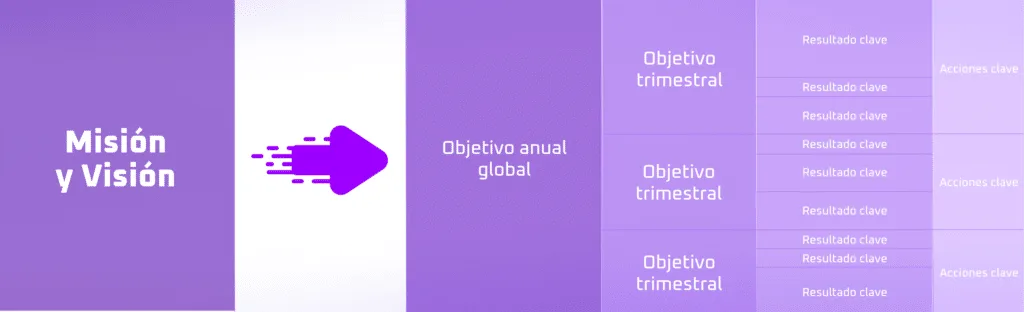
As we see, OKRs are not only a management tool, but a tool specific to the organizational culture within a company that promotes collaboration, responsibility and focus on results.
By implementing an OKR system effectively, your company can exploit its full potential and achieve even its most ambitious goals.
⚠️Remember: The key to success with OKRs lies in consistent implementation, regular monitoring, adaptation to changing market and business needs, and the commitment of the entire organization.
Would you like to implement this tool in your company? We can help you! Contact us😉