
blog · Consultancy · AI
The new role of the CEO in the era of artificial intelligence
For decades, the role of the CEO was associated with strategic decision making, business vision and the ability to lead teams. He was the figure that defined the direction and validated the most important movements of the organization.
That model worked for years because the context allowed it. The cycles were longer, the information was more limited and decisions could be made with a greater margin of time.
But that scenario changed. And it changed quickly.
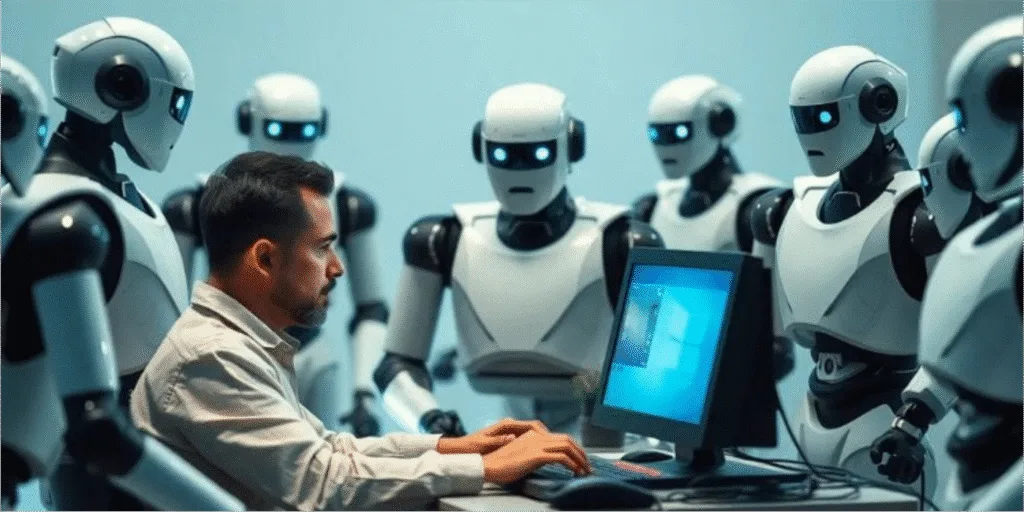
In 2026, artificial intelligence, automation and speed to market are redefining how companies operate. And when the way you operate changes, the way you lead inevitably changes.
Today, the CEO is no longer just the decision maker. He is the one who designs the system that allows these decisions to be made better, faster and with more information.
For a long time, experience and intuition were pillars of leadership. Many CEOs built their criteria based on years of experience, learning and context. That's still valuable.
But it is no longer enough on its own.
Today, decisions can be supported by real-time data, predictive models and artificial intelligence systems that process large volumes of information in seconds.
This does not replace the leader. It enhances it.
The new challenge is not choosing between intuition or data, but knowing how to integrate them. Understand when to rely on artificial intelligence and when to provide strategic vision, context and human judgment.
At the same time, speed became a central variable.
Markets are constantly evolving, competitors are continually innovating, and customers expect faster and simpler experiences. In this context, slow decisions are no longer neutral and begin to generate disadvantages.
The modern CEO must not only decide well. You must build organizations that can decide quickly without losing coherence.
This means reducing dependence on hierarchical structures, decentralizing decisions and generating enough clarity for teams to act without friction.
Speed is no longer just operational. It's strategic.
In this new scenario, a profound change appears in the role of the CEO.
Stop being the one who solves problems and become the one who designs the system that solves them.
This implies thinking of the company as an integrated system of processes, decisions and technology. Understand how work flows, where bottlenecks arise, and how to optimize the operation to scale without losing efficiency.
The CEO becomes an organizational architect.
Artificial intelligence plays a key role in this change.
It is not just a tool to automate tasks. It is a strategic layer that directly impacts decision making, operational efficiency and customer experience.
A CEO in 2026 does not need to know how to program, but he does need to understand what artificial intelligence can do, where it has real impact and how to integrate it into the business.
The companies that manage to advance in this sense are not those that have more tools, but those that apply them with greater strategic clarity.
However, one of the biggest challenges is not technological. It's cultural.
The incorporation of artificial intelligence transforms the way of working, redefines roles and generates uncertainty within teams.
If this change is not managed correctly, resistance, friction and lack of adoption appear.
The CEO has a central role in this process. Not only does he lead the strategy, he also leads the cultural transformation.
Communicating the purpose of the change, generating trust and accompanying the evolution of teams becomes as important as implementing the correct technology.
Another important change has to do with control.
In traditional models, leadership was associated with supervising, validating and centralizing decisions. But in complex environments, that approach becomes inefficient.
The new leadership is not based on controlling more, but on generating more clarity.
Clarity about objectives, priorities and limits.
When this clarity exists, teams can move forward autonomously without losing strategic alignment.
This does not reduce the role of the CEO. It transforms it into something more powerful.
Because it stops being focused on daily operations and begins to concentrate on what really generates impact: strategy, organizational design and the ability to adapt.
In a context where technology is increasingly accessible, the difference is not in who has more tools.
It's up to who integrates them best.
The CEO of the future is not the one who knows the most about technology, but rather the one who best connects technology, business and culture in the same system.
He who understands that artificial intelligence does not replace leadership, but it does completely redefine the way it is exercised.
At Lab9 we accompany companies that are going through this change, helping them integrate artificial intelligence, automation and strategy to build organizations that are more agile, efficient and prepared for growth.
Because in 2026, leading is not just about deciding. It is designing companies that can decide better.
If you need 1 to 1 advice with our CEO contact us