
blog
Tencent releases HunyuanWorld1.0: the first open model for creating interactive 3D worlds.
From imagination to a virtual world in seconds.
Imagine describing in words: “a futuristic city under a purple sky, with flying cars and shiny skyscrapers” or uploading a photo and, in a matter of seconds, having a virtual environment that you can look around in 360°.
That's what Tencent's HunyuanWorld1.0 promises: creating interactive, explorable 3D worlds from text or a single image, all using publicly available artificial intelligence.
Tencent presents it as the first open-source model designed to generate 360° panoramic scenes compatible with engines such as Unity and Unreal Engine.
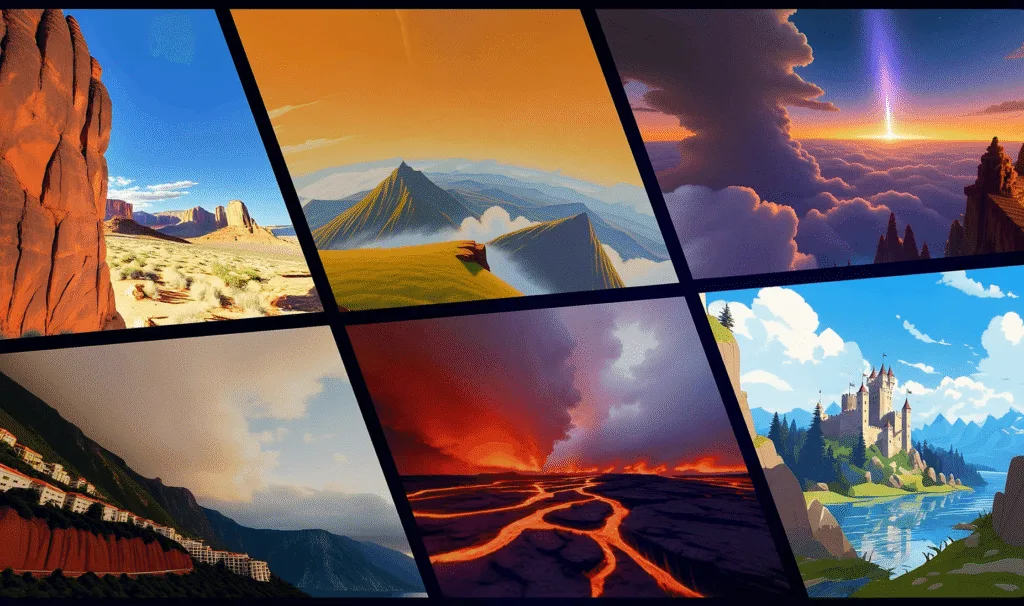
How HunyuanWorld1.0 works: technique at the service of creativity.
The system operates in two key phases:
- Panorama generation: uses a diffusion-based model called Panorama-DiT to create 360° images without distortions at seams or poles.
- Hierarchical reconstruction: starting from the panorama, it separates sky, background and objects into independent semantic layers, which are then transformed into editable 3D meshes.
These "proxy worlds" allow direct exports as editable meshes, which can be manipulated within VR environments or game engines as if they were manually constructed scenes.
Although for now the interaction is limited panorama-style navigation, not a free-world video game, the potential is enormous.
What does HunyuanWorld1.0 bring to the creative industry?
- Democratized access. It is open-source: includes weights, code and integration with standard graphic pipelines—ideal for indie studios, students and free creatives.
- Full compatibility. Works with Unity, Unreal, VR/AR and simulation environments thanks to its declarative architecture and exportable mesh.
- Basic interactivity from day one. It allows objects in the environment (trees, buildings, furniture) to be manipulated independently, which opens doors for prototypes, interactive storytelling or quick demos.
- Starting point for future innovations. Tencent also launched Hunyuan3D 2.0 with textured asset generation, and platforms such as HunyuanVideo and Hunyuan-A13B language models, all open-source.
Real applications: from design to gameplay and simulation.
Although still in its initial version, HunyuanWorld1.0 is already generating interest in:
- Design of scenarios for video games or VR experiences without having to model an entire city from scratch.
- Quick creation of environments for storytelling or architectural simulations by simply writing a phrase or uploading a visual reference.
- Prototypes of 3D experiences for e-learning training or virtual tourism, accelerating the production process.
Current limitations and technical challenges.
Today the model generates still panoramic scenes with limited interactivity. There is no free scrolling or continuity in long videos—that requires the Voyager module or future iterations.
There are also challenges in terms of graphic quality (textures and resolution), geometric consistency in complex objects, and the ability to export in lightweight formats for web or mobile environments.
Between hype and reality: what does it mean for creative innovation?
This launch marks a before and after because it puts within the reach of many the ability to generate interactive visual worlds from scratch. You no longer need a team of 3D artists or weeks of modeling: with a prompt and a click you can have a virtual space ready to explore.
But it also raises important questions:
- How to maintain control of the visual and narrative quality of something automatically generated?
- How far should manual editing go vs. the AI generation?
- How do we ensure that these tools increasingly enhance creativity rather than replacing it?
Now what?
The arrival of models like HunyuanWorld 1.0 puts in our hands a tool that five years ago seemed like science fiction: creating entire worlds from an idea or an image. It democratizes access to 3D creation, shortens time, reduces barriers and opens possibilities for creators, designers, developers and dreamers. But it also confronts us with a responsibility:
If anyone can now create a world... how do we decide what kind of worlds are worth building?